

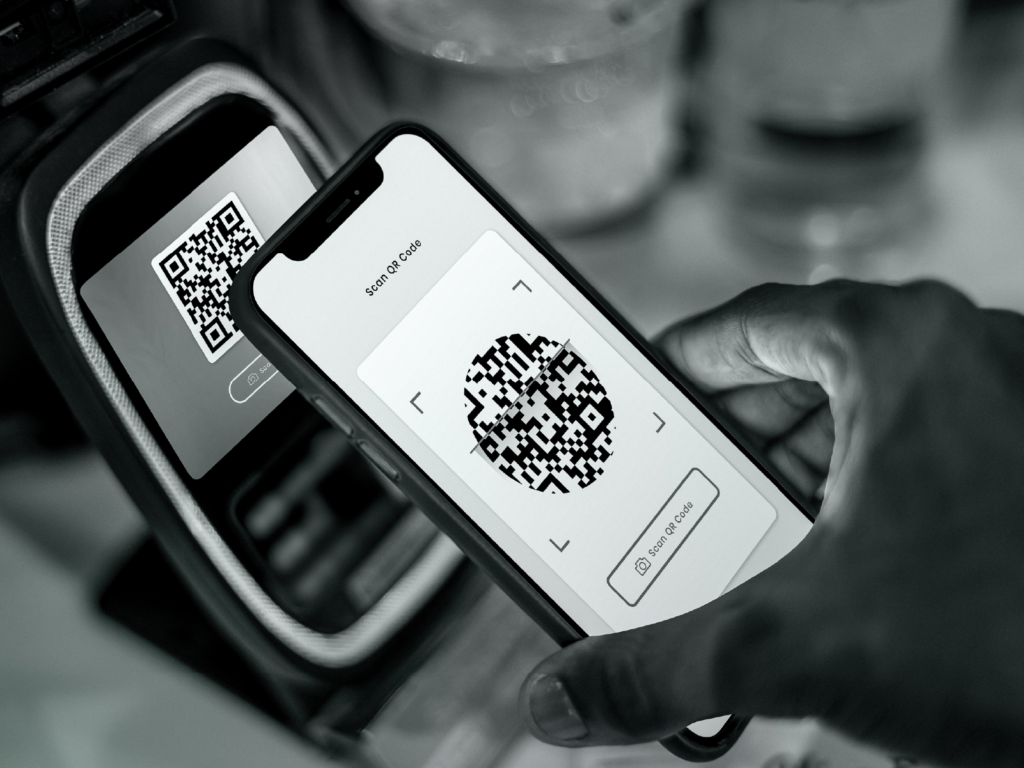
QR Codes: From a Technical Tool to a Strategic Choice
Long perceived as a mere technological gadget, the QR Code is now establishing itself as a true payment standard. In an Algerian context where cash remains dominant and POS terminals still represent a significant investment for many SMEs, QR Code payment stands out as a pragmatic, cost-effective, and immediately deployable alternative.
For BEYN, an Algerian fintech specializing in digital banking and mobile payment, the QR Code is not just another fintech innovation. It is a concrete response to the operational realities of merchants and SMEs, and a natural accelerator of payment digitalization.
A Global Momentum Opening a Local Opportunity
On a global scale, QR Code payment is experiencing sustained growth. The market, estimated at over $12 billion in 2024, is expected to exceed $17 billion by 2025. This rapid progression is no coincidence. It is driven by the widespread adoption of smartphones as the primary gateway to financial services, the maturity of security technologies, and a strongand contactless solutions.
For Algeria, this global trend represents an opportunity for a technological leap. QR Codes make it possible to bypass certain
constraints related to heavy infrastructure and accelerate thents, particularly among smaller businesses.
Why QR Codes Address the Real Challenges of SMEs
The first advantage of QR Codes for SMEs is economic. Where traditional solutions require the purchase or rental of POS terminals, QR Code payments rely on equipment already widely available: the smarastically reduces entry costs and allows merchants to digitize payment collection without significant investment, with a direct impact on profitability.
Beyond cost, security is a central concern. Contrary to cont today offers a high level of protection. Transactions aresecured by encryption, tokenization, and client-side authentication mechanisms. At BEYN, these principles are built in from the ground up, in line
with banking and regulatory standards.
The payment experience is another key driver. For the customer, the gesture is simple and fast: scan, confirm, pay. For the SME, this translates
into smoother collections, reduced cash handling, and better flows. Funds are received faster, directly improving cash flow management.
Finally, QR Codes transform every payment into actionable ically generate reliable digital records, simplifyingaccounting, reconciliation, and ultimately sales analysis. For many SMEs, this is often the first step toward more structured, data-driven management.
A Powerful Driver of Financial Inclusion
QR Code payment also plays a key role in financial inclusion. It requires neither a bank card nor a specific terminal — a smartphone is enough.
This accessibility gradually brings unbanked or underbanked pnd informal small traders into the digital economy.
In this sense, the QR Code is not just a technological innovation. It is a tool for democratizing financial services, perfectly
suited to the realities of emerging markets.
BEYN’s Vision: QR Code as a Building Block of an Ecosyste
At BEYN, we view the QR Code not as an isolated feature, but as an essential building block of an interoperable mobile payment ecosystem. It integrates naturally with e-baand all dematerialized financial services.
The technology is now mature. The real challenge lies in large-scale adoption by SMEs and in the ecosystem’s ability to offer simple, consistent,
and accessible user journeys.
Conclusion
QR Code payment is no longer a distant promise. For Algerian SMEs, it represents an immediate lever for cost reduction, an accelerator of digitalization, and a powerful tool for financial inclusion.<
Adopting QR Codes today is not about following a trend. It is about getting ahead in an economy undergoing full
transformation.